

Environmental, social and governance
ESG
Our ESG work covers material sourcing, environmental management and the people involved in production. Quality checks are established across our production stages. Traceability and carbon-footprint calculations are being implemented, while work on wastewater treatment and energy management is at an early stage.
Environment
Environmental work in a textile mill involves several different questions: how resources are used, how wastewater is managed, and how emissions are measured. These areas need separate records and methods of assessment. Our work is at different stages in each area.
Carbon-footprint calculations
We have started implementing carbon-footprint calculations to understand the emissions associated with our operations. A useful inventory sets out the activities included, the reporting period and the calculation method. It provides a basis for understanding emissions; it does not, by itself, demonstrate that emissions have been reduced.
Wastewater treatment
Our wastewater-treatment work is at an early stage of development. In textile production, treatment and monitoring need to reflect the processes generating the wastewater. Treatment performance is assessed through defined operating conditions and water-quality testing, rather than the presence of equipment alone.
Energy audits and management
Our work on energy audits and energy management is also at an early stage. An energy audit examines where and how energy is used. Energy management is the ongoing work of monitoring that use, setting priorities and reviewing results.
Quality at every production stage
Quality checks are established at each of our production stages, and we continue to improve them. Checking during production matters because a variation in the fibre, yarn or process can influence the finished article; final inspection alone cannot explain every earlier decision.
From material to finished product
An integrated production route makes it possible to consider quality across connected stages. Fibre and yarn characteristics influence how a material behaves in dyeing, weaving or knitting. Colour, construction and finishing then influence the appearance and feel of the finished product. Each stage has a different role in meeting the product specification.
Defining quality for the intended use
A product specification brings these requirements together. It may describe fibre composition, colour, measurements, construction, finishing and relevant tests. The checks and acceptance criteria need to suit the product and its intended use, rather than relying on a single claim of ‘high quality’.
Checks and records
Useful quality records identify what was checked, at which production stage, against which requirement and with what result. A production check, a laboratory test and an independent assessment provide different kinds of evidence.
Traceability
We have started implementing traceability from herders’ cooperatives to our factory. The work focuses on connecting information about fibre sourcing with the material received for production.
Following the material
Traceability means being able to follow a material through records of its origin and movement. Cooperative or supplier information, delivery records and lot identifiers each contribute to that connection. Where fibres are blended or transformed, the records need to explain how the incoming material relates to the next stage.
Responsible herding
Responsible herding standards describe expectations at the source of animal fibres. Their relevance to a product depends on which suppliers and materials are covered and how conformity is assessed. The Responsible Nomads reference below provides background on responsible herding.
Read about the Responsible Nomads standard
Understanding the scope
For a specific material or order, the important distinction is between a known source, records connecting production stages, and independent verification. These are related, but they do not demonstrate the same thing.
Certifications and audits
Certifications and audits help explain how a particular requirement has been assessed. They are most useful when read alongside their scope: the named facility, material, activity or product, and the period they cover.
Certifications
A certificate relates to a particular standard and a defined scope. The issuing organisation, certificate holder and validity dates help establish what it demonstrates. Certification of a management system is different from certification of a material or finished product; one should not be presented as the other.
Audits
An audit examines selected practices or records against stated criteria. The audit date, assessed location and areas reviewed provide context for the findings. Corrective actions and follow-up matter as well as the initial assessment. An audit report is not automatically a certificate.
Governance and accountability
Governance concerns how responsibilities are assigned, decisions are recorded and issues are followed through. For a manufacturing relationship, clear ownership of a requirement and a record of how it was addressed are more informative than a logo or a broad statement on its own.
Certificate and audit details apply to the named holder, facility and scope stated in each record.
MNS 6926:2021 Sustainable Textile Production
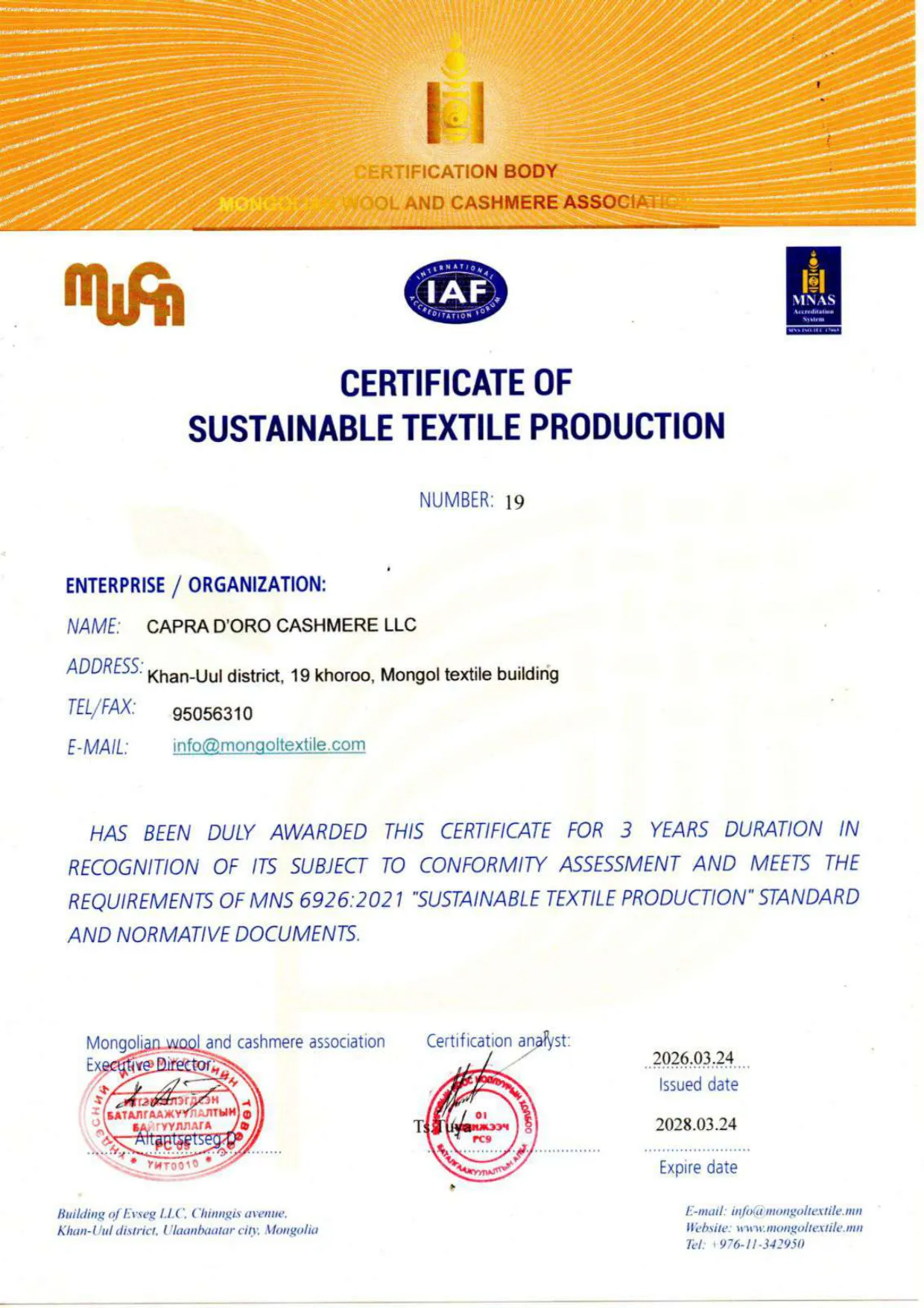
CAPRA D’ORO CASHMERE LLC was awarded Certificate No. 19 by the Mongolian Wool and Cashmere Association on 24 March 2026. The document names MNS 6926:2021 Sustainable Textile Production.
Scope and statusNamed holder: CAPRA D’ORO CASHMERE LLC. Printed issue date: 24 March 2026. Printed expiry date: 24 March 2028.
Product conformity certificate

Certificate MWCA-CC-26020256 names CAPRA D’ORO CASHMERE LLC. Its product scope covers knitted and woven finished products made from goat cashmere, camel wool and yak down under MNS 6809:2019, and cashmere yarn under MNS 5306:2024.
Scope and statusNamed holder: CAPRA D’ORO CASHMERE LLC. Printed issue date: 30 January 2026. Printed expiry date: 30 January 2029.
ICS Social Audit — 2023
CAPRA D’ORO CASHMERE’s Ulaanbaatar facility underwent an initial ICS social audit conducted by Eurofins on 7 November 2023. Subsequent corrective actions have been tracked through the ICS process.
Scope and statusHistorical initial social audit. Current follow-up status has not been verified.
Our people and workplace
The social side of textile manufacturing concerns the people involved in making a product: their rights, working conditions and experience at work. Workplace culture and formal employment practices both matter, but they describe different aspects of that experience.
Company culture and social events
Workplace culture is shaped by everyday collaboration and by opportunities for colleagues to spend time together. Social events are one part of that culture. They can support relationships across teams, while questions about working conditions and employee rights require their own information and records.
Human rights and workers’ rights
Fundamental principles at work include freedom of association and collective bargaining, the elimination of forced and child labour, non-discrimination, and a safe and healthy working environment. Understanding these principles is different from verifying how they are applied in a particular workplace.
For a workplace assessment, written policies, implementation and the experiences of workers need to be considered together. A policy describes an expectation; the way it is communicated and applied determines its practical meaning.
Health and safety
Health and safety in textile manufacturing begins with understanding the risks associated with each task. Work around machinery, the handling of materials and chemicals, and repeated movements can require different preventive measures.
Prevention in daily work
Risk assessment, equipment safeguards, clear working procedures and appropriate protective equipment play different roles. Training helps people understand both the task and the precautions it requires. These measures need to be considered together, rather than treating any one of them as proof of a safe workplace.
Review and improvement
Records of inspections, incidents and corrective actions help show how workplace risks are reviewed over time. Employee participation can also identify practical concerns that are not obvious from procedures alone. The scope and date of an assessment matter when interpreting the information.